DeFi has no shortage of lending markets, perps, and aggregators, and most of them look and feel the same. What it doesn’t have is a trustless prime broker.
That’s what Project 0 is: the first permissionless, cross-collateral, multi-venue, unified margin protocol. Allowing users to borrow, lend, and trade across venues as if it were a single account. One portfolio. One risk engine. Many markets.
Building something new for DeFi meant designing something new for users. There was no template for cross-collateral, multi-venue margin. No playbook for visualizing risk across Kamino, Drift, Jupiter, and more, in one unified portfolio. We had to invent the experience for a new financial primitive.
Our Principles: Clarity, Confidence, Composability, Performance
When you’re building a new product, principles matter. For Project 0, we set four:
- Clarity: Collapse multi-venue complexity into one clean, understandable view.
- Confidence: UX is the front door to your risk engine.
- Composability: DeFi isn’t siloed, and our app couldn’t be either.
- Performance: Web3 should feel like best-in-class Web2.
These weren’t slogans. They were daily constraints. And they’re the reason Project 0 feels simple, fast, and composable from day one.
Clarity
We built a new design system from the ground up, crafting each component for clarity and ease of use. It’s built on top of the excellent shadcn/ui framework, with a focus on modularity and full device and wallet compatibility.
We tore down and rebuilt our ActionBox, the core entry point for every action on Project 0. It now allows users to easily switch venues for a given asset, loop with another asset or existing collateral directly from the main view, and execute with fast simulations and smart error handling. The result is that every interaction on Project 0 feels fast, predictable, and consistent.
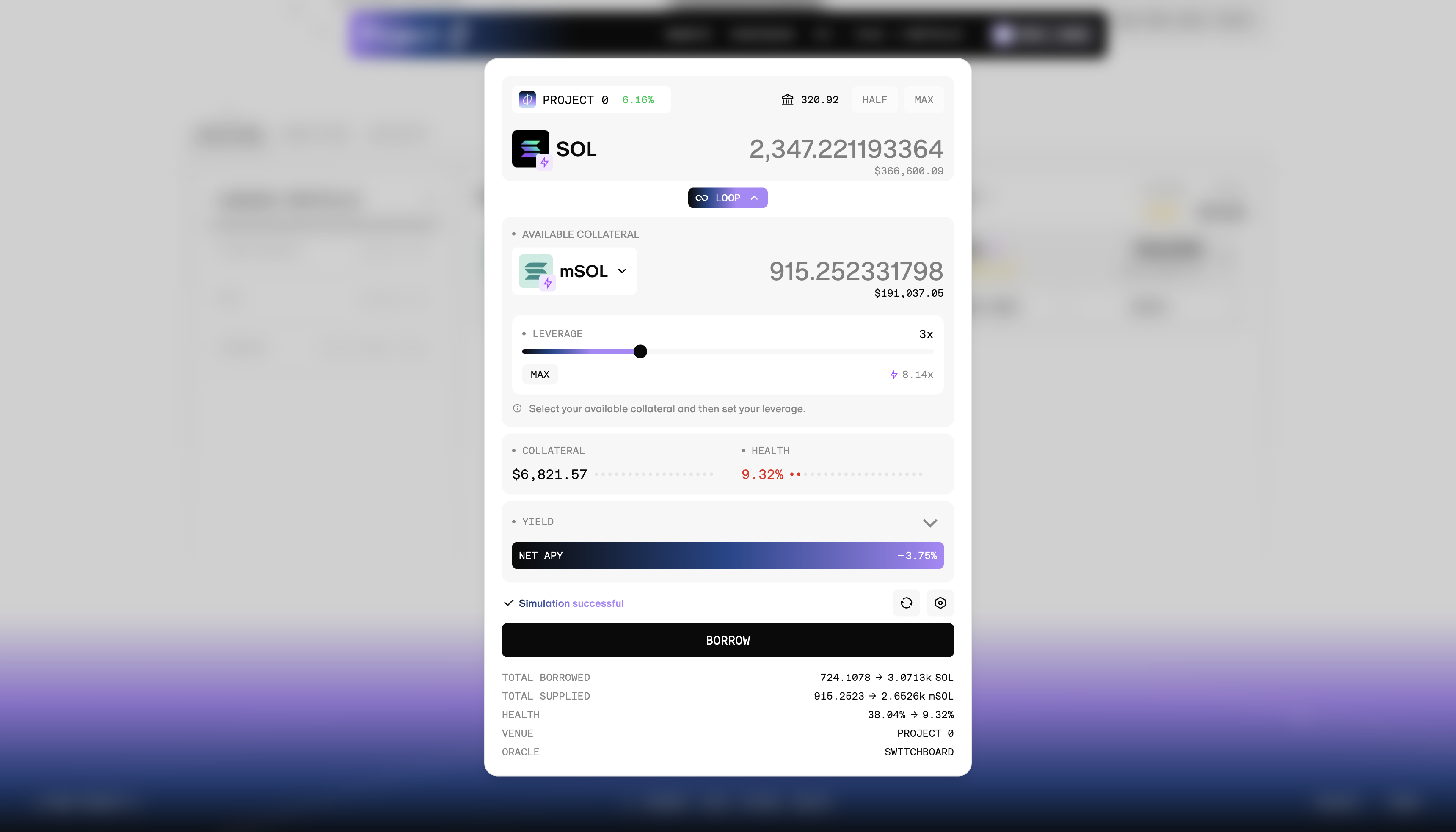
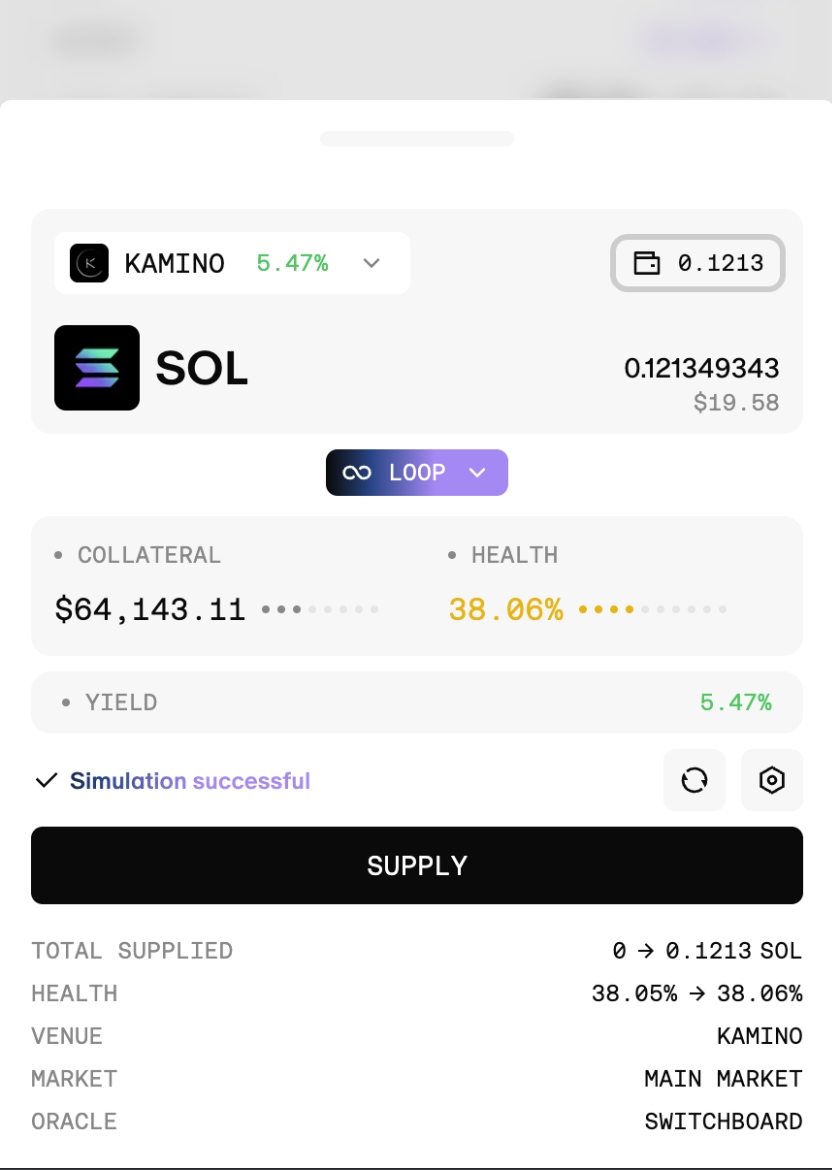
Another key innovation was our approach to dialogs. With our userbase evenly split between large trading screens and in-wallet mobile browsers, we needed a system that felt native to both. Led by senior ux engineer @borcha_vb, we designed a responsive dialog framework that adapts in real time using full-screen dialogs when space allows and switching automatically to mobile drawers on constrained devices. This keeps the experience consistent across the wide range of devices and wallets we support while optimizing for each.
Confidence
UX is the front door to your risk engine. Without clear visualization of risk and dynamic, timely warnings, users can’t have confidence in their positions or the system itself.
At the center of that experience is the Health Orb, a live visualization of every user's portfolio. It gives direct visibility into assets, liabilities, available collateral, and overall health, all coordinated through color, motion, and hierarchy. Based on early user research, we also introduced a lightweight Mini Portfolio view on the main lend and borrow pages, giving users an at-a-glance view of collateral and health while browsing or trading.
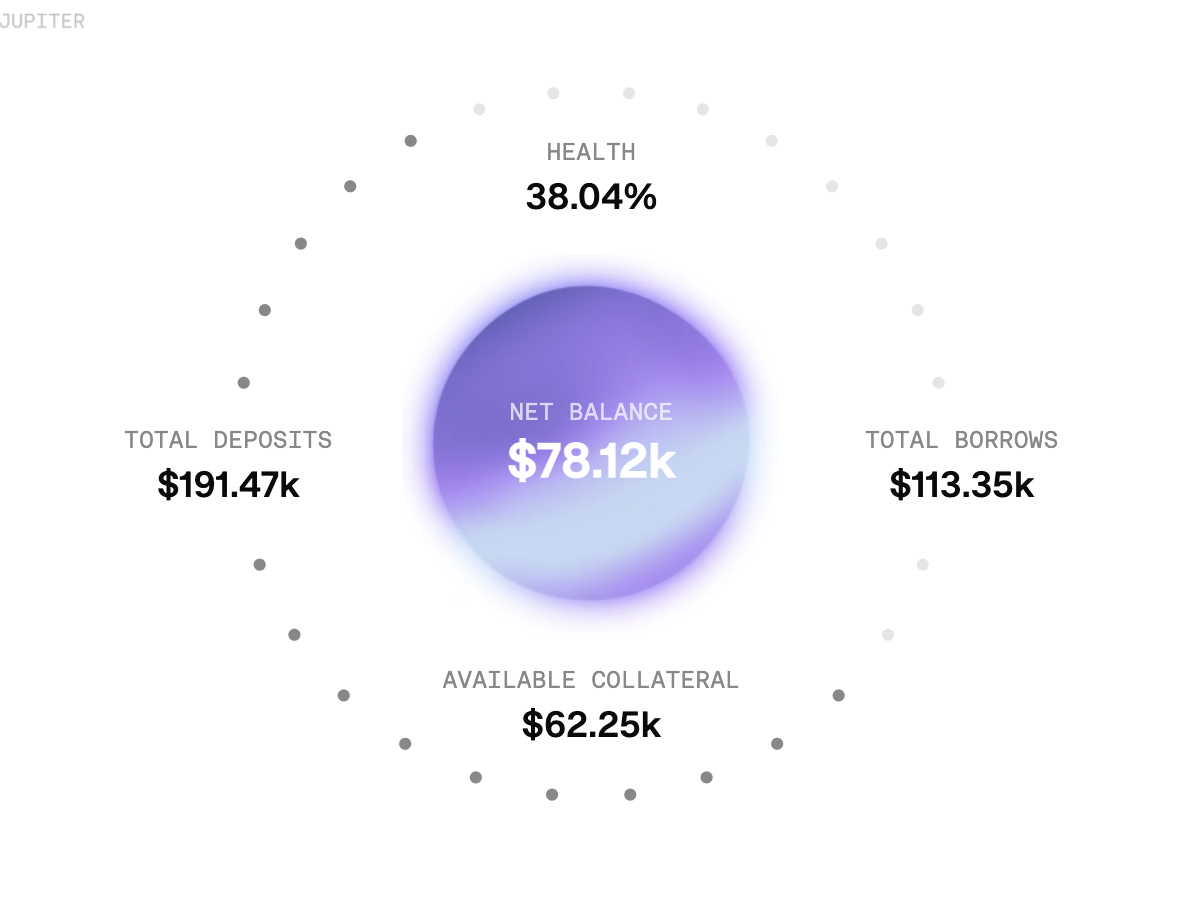
We also rethought how health and liquidation states are surfaced. Users with deteriorating health, approaching liquidation, or already in a liquidatable state receive relevant contextual warnings throughout the UI, including the Health Orb, the Mini Portfolio, and the global header visible from anywhere in the app. It’s a unified risk awareness system designed to keep users confident and in control.
Composability
Blockchains and DeFi are composable by nature, and we wanted that ethos to carry through to the Project 0 application. But integrating multiple third-party systems into one seamless experience is no small feat.
Rather than relying on a patchwork of third-party SDKs, each with its own APIs and dependency trees, we deconstructed and built lightweight wrappers on top of the underlying programs. This approach let us expose a single, unified, open-source SDK with one cohesive API. The result is a cleaner developer experience and far more predictable performance. (That deserves an article of its own.)
On top of this foundation, Project 0 introduces a first-of-its-kind innovation in DeFi: cross-venue looping.
Cross-venue looping allows users to gain leverage on collateral across venues and loop in a single transaction. Users can source collateral wherever yields are highest, loop it against a P0 borrow, and gain leverage at the most optimal APY cost basis on Solana.
This wasn't easy to build. Solana's transaction size limits required careful engineering, so we took advantage of Jito bundles to combine borrows, swaps, and cross-venue deposits, while keeping things atomic. Everything executes seamlessly in a single signing and confirmation flow.
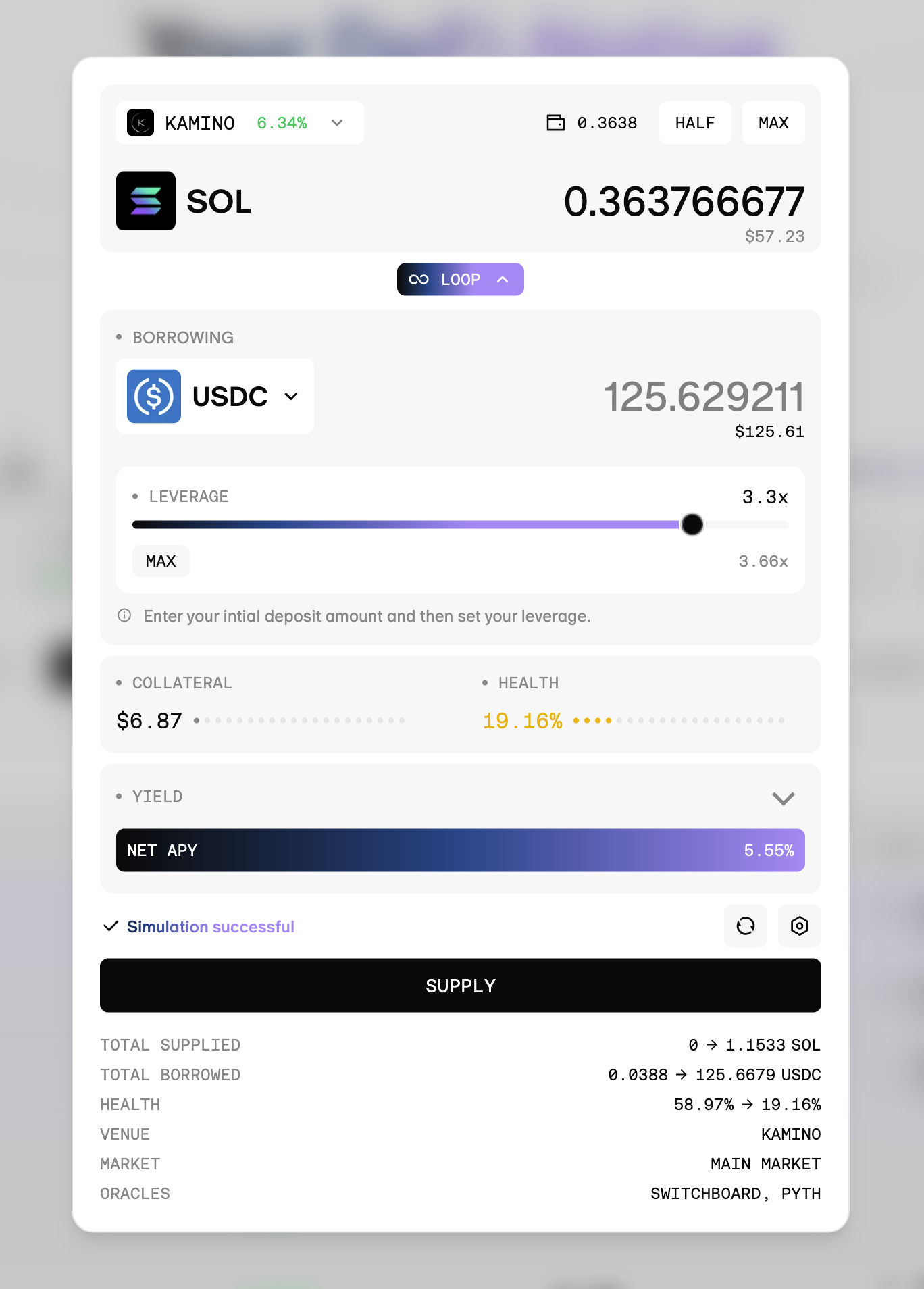
As senior fullstack engineer @kobe put it, this is what capital efficiency on Solana looks like going forward: the best collateral, the best borrowing cost, and unified liquidity.
Performance
Web3 apps are notorious for being slow and clunky. We refused to accept that. From day one, Project 0 was designed to move with the speed users expect from the best products in Web2.
In many crypto apps, data is fetched and parsed client-side, queried directly on-chain via RPC. Simulations and transactions are run in the client. It works, but at the cost of speed and reliability.
Project 0 was rebuilt around a server-first architecture. All indexed data is fetched and rendered on the server before it ever hits the client using server-side rendering (SSR) and React Server Components (RSC). Banks, rates, and balances are stored in a high-performance database rather than pulled raw from RPC, while simulations and transactions run on serverless functions distributed across Vercel’s edge network. Smart caching and background rehydration keep the experience instant, ensuring freshness without blocking the UI.
The result is blitzing load times. The app opens instantly with data already in place, and every interaction feels immediate.
And the benefits go further. SSR makes Project 0 legible to LLMs, opening a new path for discovery where AI systems can index, understand, and route users into the protocol.
These techniques are standard in Web2 but rare in Web3. We chose speed as a first principle, because the future of finance has to be fast.
Looking Forward
Project 0 isn’t a new interface on top of an old primitive. It’s a new UX for DeFi. The first true multi-venue margin experience in crypto. We’re proud of what we built, but this is just v0. The future of DeFi experiences starts here.